
Baird Foundation awards $100,000 to East Side Parkways Coalition to Support Fight to Restore Humboldt Parkway
This Matching Grant Recognizes Growing Momentum and Aims to Catalyze Additional Support
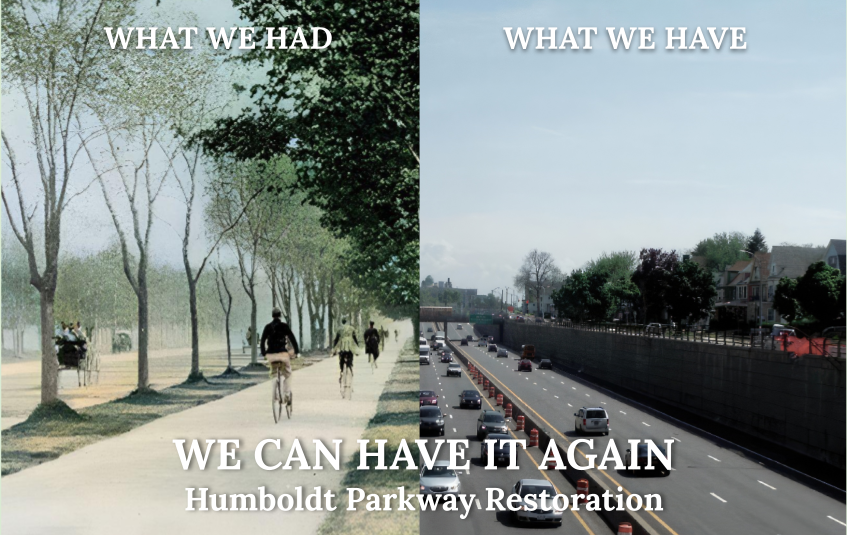
Then and now image collage via Eastside Parkways Coalition.
Buffalo – The Baird Foundation announced today the award of a $100,000.00 matching grant to the East Side Parkways Coalition (ESPC) to further their efforts to secure the complete removal of the 33 and the 198 and the full restoration of the original and historic Olmsted-designed Humboldt Parkway – the first citywide park and parkway system the United States - instead of the New York State Department of Transportation’s ill-conceived and inadequate tunnel and decking proposal.
Catherine Schweitzer, Executive Director of the Baird Foundation commented: “Humboldt Parkway was once the crown jewel in Buffalo’s network of Olmsted-designed parks and parkways, and we have a once-in-a-lifetime opportunity to make it so again. But we won’t get there by replacing a portion of it with a tunnel. The East Side Parkways Coalition has fought to ensure the best outcome for the community and we are proud to stand with them and to provide this financial support at this critical juncture.”
The contribution is made in acknowledgment of the ESPC’s tireless advocacy that has resulted in three major recognitions over the past year: the designation of the restoration as the number one priority on the Partnership for the Public Good’s 2025 Community Agenda; the inclusion on the Preservation League of New York State’s Seven to Save list; and the national Olmsted Network’s President’s Award. As a matching grant, the Foundation’s funds are intended to catalyze additional support from individual and corporate donors, foundations, and other sources, and will be utilized for advocacy efforts, marketing, informational meetings and community events, legal fees, and other such expenses necessary to succeed. Interested parties can securely make a donation at eastsideparkwayscoalition.com/donate.
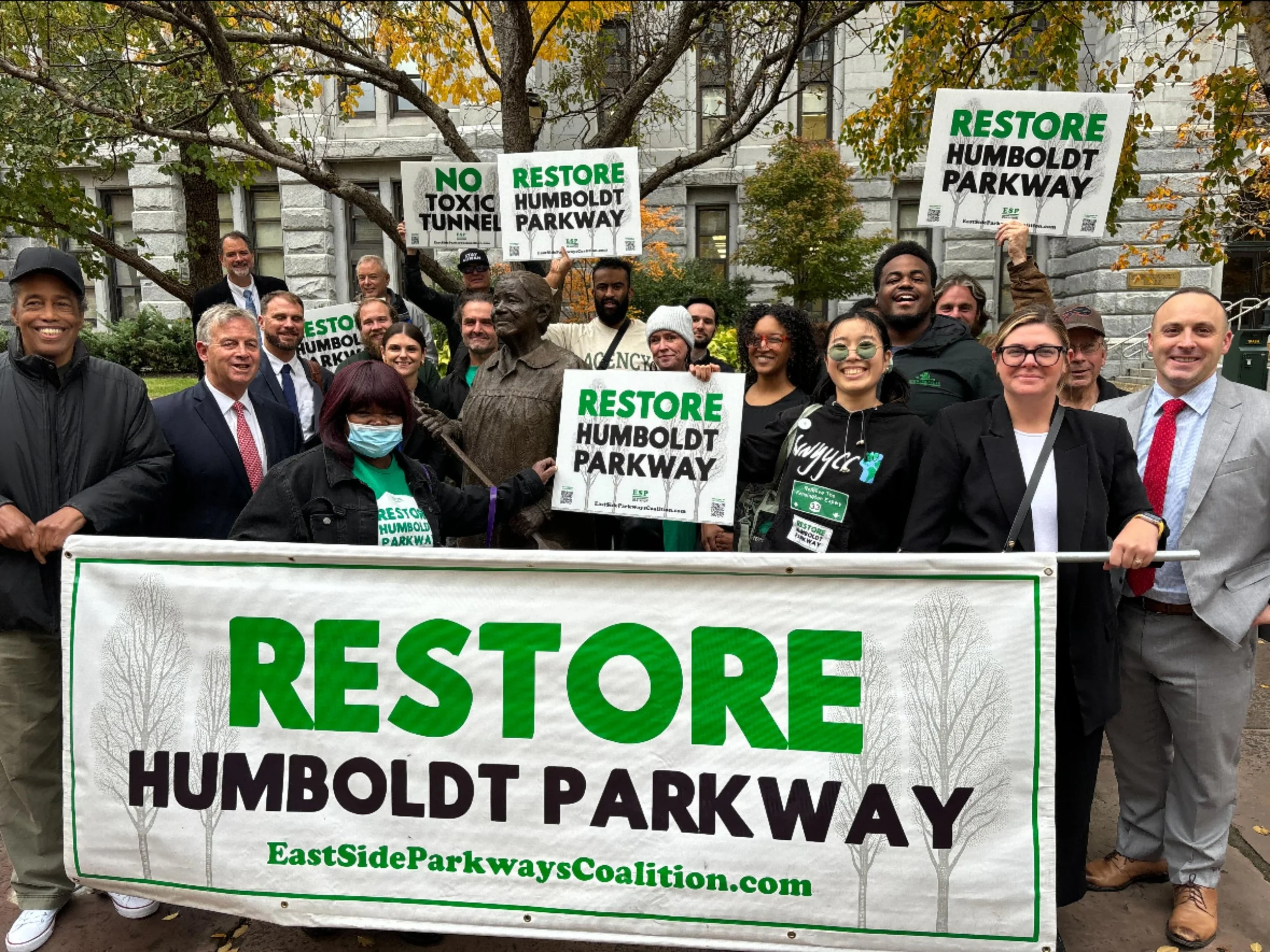
ESPC and community members demonstrating with signs and a banner in support of a restored Humboldt Parkway.
Candace Moppins, ESPC Board Chair thanked the foundation for their unwavering support: “The Baird Foundation’s support has been instrumental in our successes so far, and these funds will be indispensable as we move forward. The importance of getting this project right cannot be understated, as it will be generationally transformational, not just for the immediately surrounding neighborhoods, but for the city as a whole.”
The NYS Department of Transportation’s proposed tunnel fails to address the community’s goal of restoring parkland and addressing the devastating impact the construction of the 33 and the 198 has had, and continues to have, on the surrounding community. In fact, the DOT’s tunnel would actually prevent the possibility of reconnecting Delaware Park and Martin Luther King Park. Not only would total restoration of the original parkway fully reconnect these two parks, but is estimated to take less time to complete and at least one-third of the cost of the tunnel. Studies conducted by the Greater Buffalo Niagara Regional Transportation council have found that radial streets are more than capable of handling the current traffic levels, in some cases with capacity to spare.
In naming the project its top priority, the Partnership for the Public Good said: “The Partnership for the Public Good is proud to stand with community in supporting the Eastside Parkways Coalition, the top-voted plank on our 2025 Community Agenda. The Coalition and Humboldt Parkway residents reached a major milestone with a successful lawsuit and a January 2025 ruling requiring NYSDOT to reevaluate its $1.5B tunnel-and-cap proposal. Successful highway removal and reversal of urban renewal’s harms is possible. We look forward to a truly robust, community-led hearing process for a brand-new project that centers the needs of Humboldt Parkway and Eastside residents.”
More than 30 municipalities across the country have undertaken "Highways to Boulevards" restoration projects, with the stated intent of "Reconnecting Neighborhoods and Strengthening Communities." Yet Buffalo’s is unique in being the first linked parks and parkways design of its kind in the country, conceived by a world-renowned designer, and a UNESCO heritage eligible site. Closer to home, Rochester undertook the replacement of their “inner loop” which closely resembles the 33. In its first stage, the City – which was the lead agency on the project, not the DOT – infilled 2/3 of a mile of the loop, which resulted in, among other benefits, more than $200 million in private investment along that stretch of the loop. The success has led the City to plan for the replacement of another 1.5 miles.
Economic revitalization and the restoration of historically significant parkland are certainly important, but addressing the negative health impacts on nearby residents must be given priority consideration. The DOT’s original proposal included five air quality improvement facilities that would mitigate the pollutants from exhaust fumes, but this is no longer part of the DOT’s plan. Their removal means that the tunnel will actually increase greenhouse gas emissions and contribute to worse health outcomes for residents. These negative impacts were among the factors that led State Supreme Court Justice Emilio Colaiacovo to conclude in his February 2025 ruling that the NYS DOT must conduct a full Environmental Impact Statement for the project. In that ruling, the Judge found that “the State failed to give due consideration to pertinent environmental factors”, that the project “had numerous potential adverse impacts”, and noted the “irreparable harm that would result if this project began without an ElS.”
Schweitzer added: “We should not be prioritizing a marginally quicker commute over the health and welfare of the residents of the surrounding neighborhoods, or the 75 years enduring the negative consequences caused by the destruction of the parkway. Removing 42 acres of parkland and hundreds of mature trees for a toxic speedway led to generations suffering the worst health impacts in the country. The profound human cost of that trade-off is immeasurable. The decisions about how to proceed should be made by the residents whose lives are impacted by them, not by Department of Transportation bureaucrats in Albany.”
The ESPC encourages residents to visit their website’s FAQ page where much of the misinformation surrounding the project is addressed.
ESPC’s efforts and the significance of this site have also been recognized by the Preservation League of New York State, which included it in their 2025-2026 Seven to Save Endangered Sites list. President Jay DiLorenzo commented: “Bravo to the Baird Foundation! The Preservation League of New York State is proud to support the work of the East Side Parkways Coalition and local advocates through listing on our Seven to Save Endangered Properties List. Returning the Humboldt Parkway to the East Side will be an important step in correcting some of the damage done to this neighborhood by the construction of the Kensington Expressway. This grant will serve as jet fuel for this important initiative.”
Bernice Radle, Executive Director, Preservation Buffalo Niagara said: “The Seven to Save designation, pursued by Preservation Buffalo Niagara, is a rare and significant recognition that underscores the urgency of restoring Olmsted’s Humboldt Parkway and reconnecting neighborhoods divided by the Route 33 expressway. Rochester, Milwaukee, and Providence have demonstrated that removing highways can work, and Buffalo can learn from these peer cities as it charts a path forward.”
Finally, the Olmsted Network (formerly the National Association for Olmsted Parks), the only national organization dedicated to preserving Olmsted’s legacy and his vision of parks as sites for healing, congregating, and equitable access to green space, honored the ESPC with their 2025 President’s Award. "The East Side Parkways Coalition is doing inspiring work to bring the community together to right a longstanding wrong that has affected community health and access. The Olmsted Network is thrilled to see their leadership recognized," said Sue Breitkopf, President, Olmsted Network.
Schweitzer concluded, “We are seven years away from recognizing Buffalo’s 200th anniversary, and the beginning of our third century as a community. Together, we have an unparalleled opportunity to correct a tragic decision that devastated portions of our community and to choose what kind of legacy we want to leave for future generations. Full restoration of the Humboldt Parkway is the only correct choice to dramatically enhance Buffalo’s future quality of life. I would argue it is not just an opportunity to do the right thing, it’s an obligation.”