Posts in Tax Credits
New Version of the Historic Tax Credit Growth and Opportunity Act (HTC-GO) H.R. 2294 Introduced in the House of Representatives — Advocacy Needed!

Join us in reminding our New York Congressional Representatives that historic preservation can provide opportunities to aid in nationwide economic recovery as we look towards our post-COVID-19 future.

Urge your Representative to Cosponsor HTC-GO. Thank you to NY Representative Brian Higgins for leading the way on this important legislation!

What’s in the New Version of the HTC-GO Legislation?

Temporary Provisions

The HTC-GO legislation (H.R. 2294) temporarily increases the rehabilitation credit (IRC § 47) to address projects impacted by the pandemic.

  • This provision increases the HTC percentage from 20% to 30% for 2020 through 2024.

  • The credit percentage is phased down to 26% in 2025, 23% in 2026, and returns to 20% in 2027 and thereafter.

Justification: Developers and building owners are experiencing challenges in rehabbing historic buildings. The financial markets have slowed, making it difficult for projects to access capital and stalling complex historic real estate developments. The increased volatility in the market and project risk is forcing banking institutions to decrease their loan frequency and the overall amount while tightening underwriting requirements. Increases in material and construction costs and an uncertain tenant market have further impacted potential developments. As a result, many projects have stalled or are no longer feasible.

Permanent Provisions

  • Increases the credit from 20% to 30% for projects with less than $2.5 million in qualified rehabilitation expenses, making it easier to complete small rehabilitation projects.

  • Lowers the substantial rehabilitation threshold, making more buildings eligible to use the HTC.

  • Eliminates the requirement that the value of the HTC must be deducted from a building’s basis (property’s value for tax purposes), increasing the value of the HTC and making it easier to pair with the federal Low-Income Housing Tax Credit.

  • Makes the HTC easier to use by nonprofits for community health centers, local arts centers, affordable housing, homeless services, and others by eliminating IRS restrictions that make it challenging to partner with developers.

Justification: The above provisions would make important changes to the HTC to encourage more building reuse and redevelopment nationwide and would particularly benefit small, midsize, and rural communities. These provisions would not only make the credit easier to use and more historic properties eligible, but it would also enhance the value of the HTC and make the credit easier to use to create affordable housing.

Contact your reps today to let them know these are incentives that are important to you, your organization or business, and community. The National Trust for Historic Preservation (NTHP), The National Trust Community Investment Corporation (NTCIC), and the Historic Tax Credit Coalition (HTCC) are pushing hard for these inclusions, with support from the Preservation League of NYS in New York, but your representatives need to hear from their constituents!

  • Visit the websites of your NY House Representatives and Senators

    • Send a message to your Representative through their website and select “tax” or “taxation” as the issue area.

    • Or call (during office hours) the office of your House Member. Introduce yourself as a constituent and ask for the email address of tax staff.

  • Draft your message using the following talking points:

    • Historic Tax Credit projects will help revitalize our communities and support our nation’s economic recovery. Many projects continue to experience profound challenges on-site and in the financing realm, due to the pandemic.

    • Now is the time to strengthen this proven incentive to address the slowdown in rehabilitation projects across the country, particularly smaller projects in our main street communities and downtowns.

    • Would the Representative please cosponsor the Historic Tax Credit Growth and Opportunity Act, sponsored by Rep. Blumenauer and Rep. LaHood?

    • These provisions were included and passed in the House Infrastructure bill (H.R. 2) in July 2020. Please look for opportunities to include these provisions in future infrastructure legislation.

    • Note any examples you may have that describe obstacles that local HTC projects have faced during the pandemic, such as delays, extra costs incurred onsite, and project financing difficulties and describe how projects would benefit from a temporary provision that increases the HTC from 20% to 30% (like leveraging more investor equity etc.) and explain how the permanent HTC provisions in the House-passed infrastructure bill would help projects and contribute to the economic recovery.

You may wish to share the HTC Fact Sheet and related legislation with Congressional Offices and review the project lists in your region.

For further assistance with your advocacy, contact: NTHP, NTCIC, HTCC, or PLNYS:

Looking for a recap on how we got here? Catch up with the recording of the January 26 New York federal advocacy webinar.

In case you missed it...Biden tosses former president Trump's classical architecture order. Read more.

Updates on the State Budget Bills

On Saturday, March 13, the New York State Assembly and Senate released their FY2022 budget bills.

The Preservation League was thrilled to see that the Assembly included the NYS Historic Tax Credit increase for small projects in their budget bill. This provision will improve Historic Tax Credit access for buildings on our Main Streets and the small two and three-story apartment houses in our villages and urban neighborhoods. The Historic Tax Credit is also a proven job creator, with one job for every $12,000 of revenue investment.

Thank you to our lead sponsor, Assemblywoman Carrie Woerner, as well as Assemblymembers Englebright, McDonald, Clark, Durso, and Magnarelli, who co-sponsored the bill introducing this NYS Historic Tax Credit improvement. We look forward to working with them and our friends in the NYS Senate to support this improvement in the final negotiated NYS Budget.

We were also relieved to see that both the Assembly and the Senate intentionally omitted the Governor's 30-day amendment that disbanded the Canal Recreationway Commission while creating a duplicative new public benefit corporation and increasing the NY Power Authority's bonding ability.

Thank you to the legislators on both sides of the aisle that came together to protect our National Historic Landmark NYS Canal System.

What can you do to ensure these actions are included in the final budget?

Please contact your legislators and thank them for protecting our National Historic Landmark NYS Canal System and underscore the importance of expanding access for the NYS Historic Tax Credit for small projects. 

NYS, Tax CreditsPLNYS Staff
Memorandum of Support A.3670 (Woerner) and S.4439 (Kennedy)

We write in support of Bill A.3670 (Woerner) and S.4439 (Kennedy) relating to improving access to the NYS Historic Rehabilitation Tax Credit for small projects. We urge the Assembly and Senate to include this bill in their budget bills this March. These improvements will help small business and Main Street building owners rehabilitate their historic buildings, while ensuring that the NYS Historic Tax Credit serves as an incentive throughout our upstate urban centers.

Click here to read our full letter of support.

Tax Credits, NYSPLNYS Staff
2021 Advocacy Priorities
advocacy priorities graphic with NYS Capitol building in background

The past year brought many challenges. The COVID-19 pandemic, which continues to ravage our nation resulting in significant loss of life and livelihoods, has also caused great difficulty for businesses and nonprofits across the state. We encourage the role that historic preservation can play in New York State’s economic recovery. Preservation projects create jobs, leverage private investment, and bring life to New York’s Main Streets and historic neighborhoods.

During the 2021 New York State legislative session, the Preservation League's policy team is working to advance the Preservation League's mission through the following initiatives and advocacy work:

  • Increasing the Historic Tax Credit from 20%-30% for projects under $2.5 million [Assembly: A03670, Senate: S04439]

  • Protecting the authenticity and integrity of our National Historic Landmark NYS Canal System, the oldest continuously operating canal system in our country by removing the Canal System Revitalization Act from the budget. We ask the NYS Legislature to intentionally omit it from their budget bills.

  • Rethinking the Governor's proposed Empire Station Complex to limit demolition of National Register-listed and eligible buildings surrounding Penn Station. Our specific legislative ask is for the proposed $1.3 billion Capital Projects Budget appropriation (page 854) for this urban renewal land grab to be removed from the Legislative budget bills.

  • Funding for NYS Office of Parks Recreation and Historic Preservation (NYS OPRHP) and the NYS Council on the Arts

    • Including support for capital investment at NYS OPRHP, with particular attention to the needs of NYS Historic Sites, as well as historic buildings and landscapes within NYS Parks

  • Maintaining Historic Preservation Grants under a $300 million Environmental Protection Fund

  • Support of the commemoration of the 250th anniversary of the American Revolution [Assembly: A04742, Senate: S04410]

  • Thoughtful siting consideration for the renewable energy our state needs to ensure a sustainable future

You can read more about our key issues reflected in our response to Governor Cuomo’s proposed 2022 budget.

Read our September 2020 letter to the Office of Parks, Recreation, and Historic Preservation highlighting our NYS budget priorities.

Our first-ever Virtual Preservation Advocacy Day took place on February 24, 2021.

On the federal level, we look forward to working with the new administration Congressional leadership to further emphasize historic preservation as one solution to a nationwide economic recovery. To accomplish this, we are currently focused on:

  • Supporting COVID-19 relief provisions related to historic preservation under the federal historic tax credit program. We anticipate Congress will introduce a bill this month drawing upon provisions of the 2019 HTC-GO bill and the 2020 H.R. 2 infrastructure bill (Moving Forward Act).

    • The Moving Forward Act included temporary COVID-19 relief to HTC projects distressed by the pandemic.

    • HTC-GO proposed several permanent enhancements to the Fed HTC to bring more value to HTC transactions and encourages redevelopment of smaller, income-producing properties.

  • Full funding of the Historic Preservation Fund.

March 8 – 11, 2021, Advocate for the HTC Virtually at Preservation Advocacy Week 2021. Virtual conference hosted by Preservation Action & National Conference of SHPOs.

The League stands at the ready to advocate for additional needs related to historic preservation in this ever-changing environment.

Tax CreditsPLNYS Staff
Rutgers University releases FY19 Economic Impact Report Outlining Benefits of the Federal Historic Preservation Tax Incentives Program

Earlier this month, the much anticipated FY19 economic impact report of the federal historic tax credit was published. This report highlights the success of the federal historic tax credit program nationwide specifically, that it generated $6.2 Billion in GDP and created 109,000 Jobs in 2019. Meaningful impacts of the program can also be seen here in New York, with $550 million in GDP, and 9,561 jobs created. Further evidence that the historic tax credit program has an incredibly important role as the nation looks toward a post-pandemic economic recovery.

"For more than 42 years, the Federal Historic Preservation Tax Incentives program has enabled the preservation and rehabilitation of more than 45,000 historic properties, while generating more than $188.2 billion in GDP nationally,” said Margaret Everson, Counselor to the Secretary, exercising the delegated authority of the National Park Service Director. “This is an incredible example of a federal/state partnership that continues to drive investments in historic preservation and revitalize communities across the country."

Tax Credits, FederalPLNYS Staff
Rutgers University releases FY19 Economic Impact Report Outlining Benefits of the Federal Historic Preservation Tax Incentives Program

Earlier this month, the much anticipated Annual Report on the Economic Impact of the Federal Historic Tax Credit for Fiscal Year 2019 was published. This report highlights the success of the Federal Historic Tax Credit program nationwide, specifically that it generated $6.2 Billion in GDP and created 109,000 jobs in 2019. Meaningful impacts of the program can also be seen here in New York, with $550 million in GDP and 9,561 jobs created. This report provides further evidence that the historic tax credit program has an incredibly important role as the nation looks toward a post-pandemic economic recovery.

"For more than 42 years, the Federal Historic Preservation Tax Incentives program has enabled the preservation and rehabilitation of more than 45,000 historic properties, while generating more than $188.2 billion in GDP nationally,” said Margaret Everson, Counselor to the Secretary, exercising the delegated authority of the National Park Service Director. “This is an incredible example of a federal/state partnership that continues to drive investments in historic preservation and revitalize communities across the country."

Tax Credits, FederalPLNYS Staff
League submits budget letter to OPRHP Commissioner Erik Kulleseid

Click here to read the League’s support letter.

We are pleased that 17 partner organizations signed-on showing overwhelming support for the following preservation initiatives increasing the historic tax credit from 20% to 30% for small projects, renewing the historic barn tax credit, maintaining funding for historic sites, support for the Environmental Protection Fund, and inclusion in a future Environmental Bond Act. All of which will provide much needed economic stimulus in a post-COVID economy in New York State. We look forward to continuing to work with the agency and our colleagues on important preservation matters.

NYS, Tax CreditsPLNYS Staff
House Passes H.R. 2 Infrastructure Bill

House Passes H.R. 2 Infrastructure Bill, inclusive of HTC-GO Enhancements & Temporarily Addressing COVID-19 Distressed Projects 

The Invest in America Act [aka the Moving Forward Act], includes $1.5 trillion to fund infrastructure projects. It dedicates about $400 billion in infrastructure investments for roads, bridges, and transit, and includes key Historic Tax Credit (HTC) improvements and temporary measures related to COVID-19 recovery endorsed by the historic preservation community.

Thank you to our New York House Representatives for supporting this effort, including those who co-sponsored the bill: Yvette Clarke [NY-9], Adriano Espaillat [NY-13], Brian Higgins [NY-26], Carolyn Maloney [NY-12], Sean Patrick Maloney [NY-18], Gregory Meeks [NY-5], Joseph Morelle [NY-25], Thomas Suozzi [NY-3], Paul Tonko [NY-20], Nydia Velazquez [NY-7].

A big thank you to all of our supporters who joined us in this advocacy effort. Your efforts and support of the Preservation League clearly communicated how important preservation is to our economic recovery. This legislation supports preservation in the following ways:

  • temporary increase for all federal historic tax credit projects to aid in post pandemic recovery (30% through 2024, stepping back down to 20% by 2027), and a temporary extension to rehab deadlines impacted by the pandemic;

  • Make permanent most of the provisions in the Historic Tax Credit Growth and Opportunity Act, H.R. 2825/S. 2615 (HTC-GO) including: 30% Historic Tax Credit for projects under $2.5 million;

  • Eliminates the HTC Basis Adjustment, bringing more value to HTC’s;

  • Reduces the Historic Rehab Test to 50% of a building’s basis instead of 100%; 

  • Makes the credit easier to use by nonprofits; and

  • Includes a provision for communities to rehabilitate existing public schools using the HTC.

Join our continuing advocacy efforts:

Contact Senators Chuck Schumer and Kirsten Gillibrand to share how HTC projects impacted by the pandemic would benefit from temporary HTC provisions in emerging COVID-19 relief Senate legislation. Explain how these enhanced and temporary HTC provisions would bring relief to distressed projects. Suggested messaging to Senators:

  • “Please include these needed HTC enhancements that were in the recent House infrastructure bill (H.R. 2) to the next Senate bill, so it may be used as a tool to enable future projects to aid in the economic recovery.”

  • Describe obstacles that local projects have faced during the pandemic, such as extra costs incurred and project financing difficulties.

  • Share the HTC Recommendations for COVID-19 Relief and Recovery Legislation 

  • Explain how the recommended provisions would help these projects and bring back the pipeline of HTC projects that are stalled in your community.

Moving Forward Act (H.R. 2)

We applaud the House for recently introducing the Moving Forward Act, to aid in COVID-19 response and recovery. Investment in our communities will greatly aid in this response, and historic preservation is key to revitalization efforts. Page 86 of the Act outlines a way to leverage investment by temporarily increasing the Historic Tax Credit (HTC) from 20% to 30% for 5 years. Further, it amends the disqualified lease rules, making the HTC easier for nonprofits and other tax-exempt entities to access it by including projects like health care centers, arts organizations, community services, workforce training providers, and others to use the HTC. This legislation also includes several provisions of the Historic Tax Credit Growth and Opportunity Act, which we have been supporting this past year. 

You can help by contacting your New York Congressional Representative and encouraging them to co-sponsor the Historic Tax Credit Growth and Opportunity Act in the House, and ask Senators to support the introduction of similar legislation. 

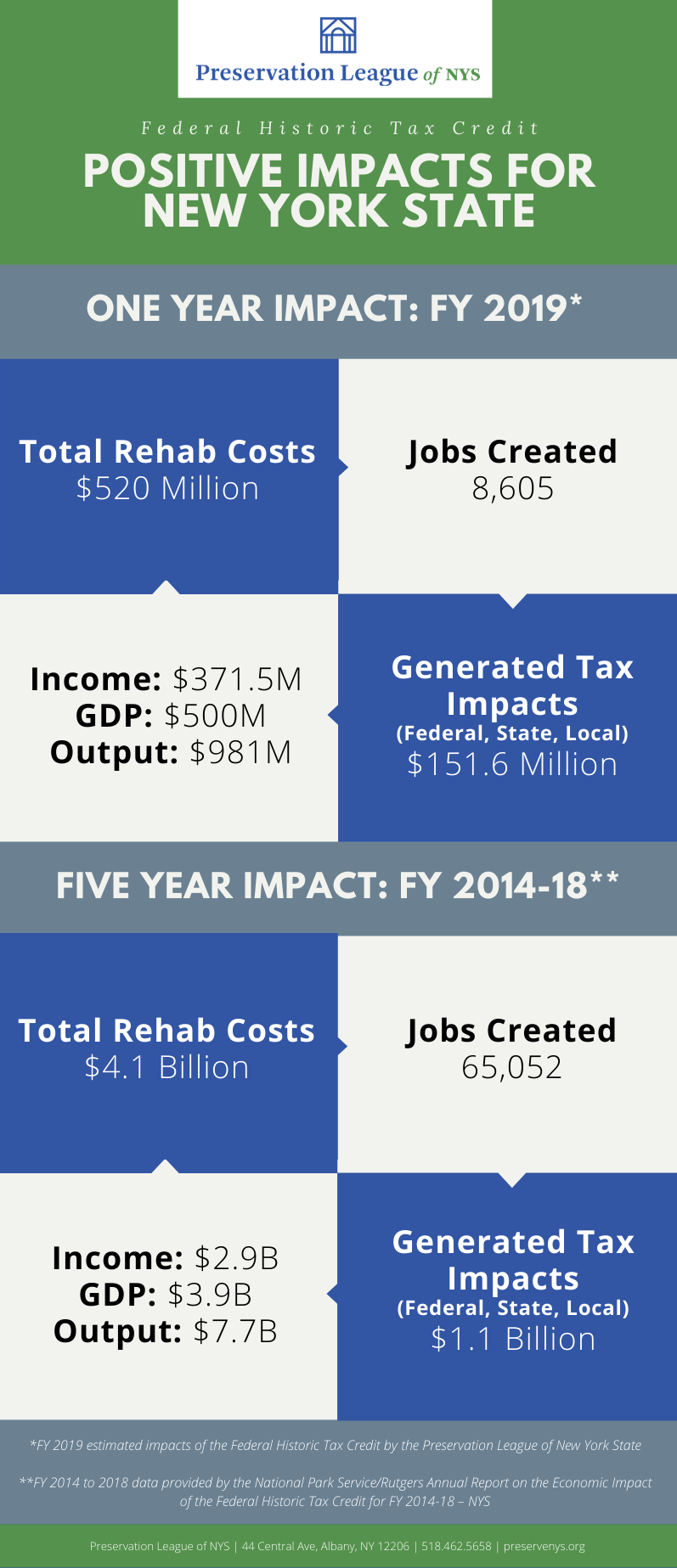
Federal HTC: Positive Economic Impacts for New York State

Federal Historic Tax Credit Program | Positive Economic Impacts for New York State

The impact of historic preservation goes far beyond that of preserving historic architecture and our history. Positive economic results are achieved through the federal historic tax credit program, which can be credited with stimulating investment, creating jobs, generating taxes, and increasing income/GDP/Output. The National Park Service along with Rutgers prepares a yearly report on the Economic Impact of the Federal Historic Tax Credit. While the 2019 report is not yet available, the Preservation League has estimated the 2019 data in the interim and provides a look between those estimates and the program numbers from FY 2014-2018.

htc infographic
Tax CreditsPLNYS Staff